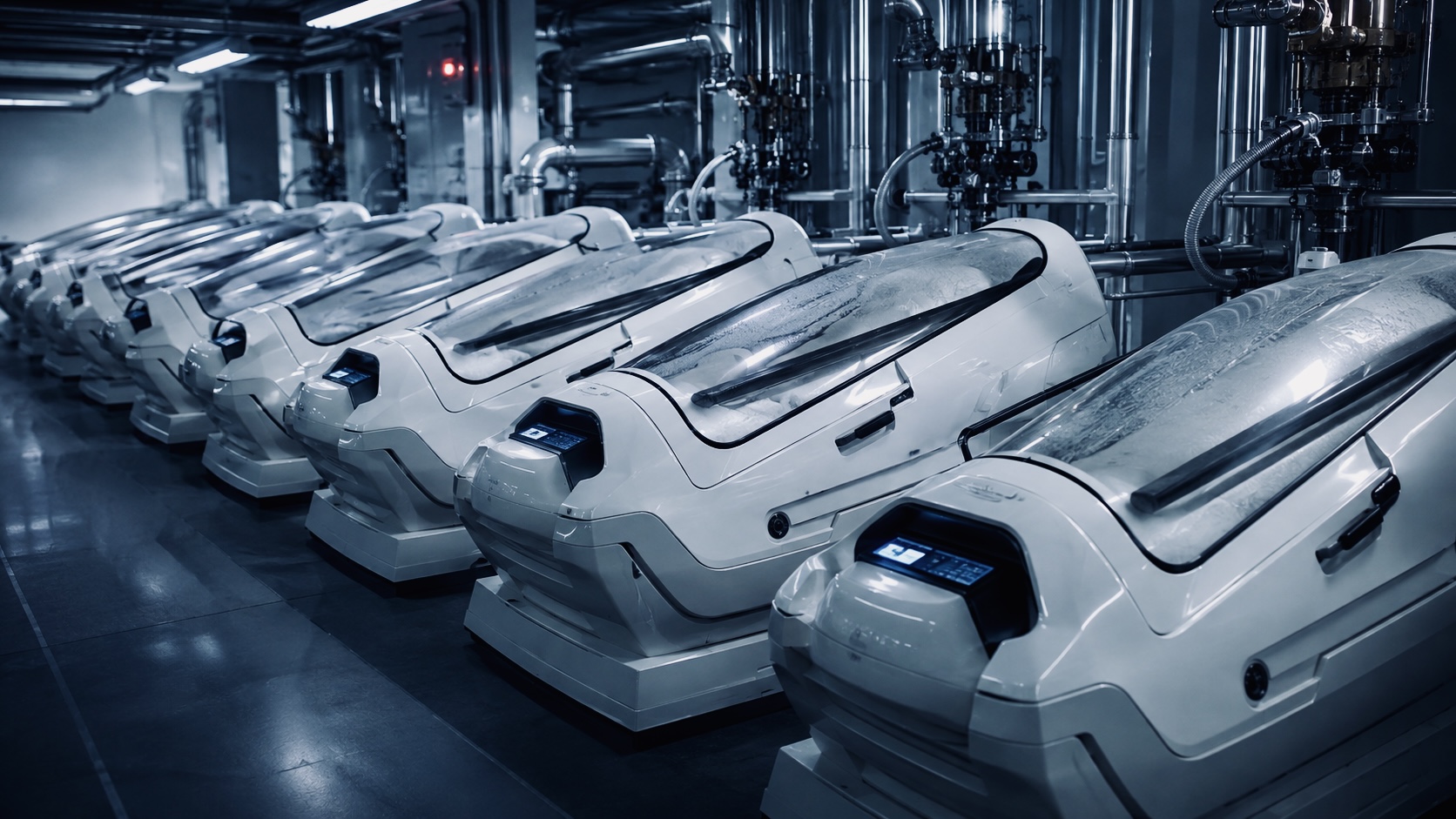
Cryopreservation can keep cells, embryos and even some animal organs viable at extremely low temperatures, but restoring a cryonically preserved human remains beyond modern medicine.
THE UNIVERSAL RECORD
Sourced reporting. No opinions.
Brad Socha | August 26, 2026 | 5:25 AM EST
Cryonics rests on an extraordinary proposition: preserve a person at extremely low temperatures after legal death in the hope that future medicine might repair the damage, cure the condition that caused death and restore the individual to life.
Parts of that idea are grounded in established science. Cells, sperm, eggs, embryos and some tissues can survive cryopreservation. Researchers have also made important advances in preserving and restoring complex animal organs. But the leap from preserving biological material to reviving an entire human being — particularly a human brain containing memories and identity, is enormous. No cryonically preserved human has ever been revived, and there is currently no demonstrated method capable of doing so.
The distinction begins with what cryonics actually does. Popular descriptions often say a body is “frozen,” but modern cryonics aims to minimize ordinary ice formation through vitrification.
Cryoprotective chemicals are introduced into tissues before deep cooling. At sufficiently low temperatures and suitable concentrations, the goal is for biological material to enter a glass-like state rather than form large ice crystals that can rupture cells and disrupt tissue architecture.
Vitrification is a legitimate cryobiological technique. It is already used in reproductive medicine, including the preservation of human embryos. But successfully vitrifying and recovering small biological specimens is fundamentally different from preserving and reviving an entire adult human.
What Cryonics Can, and Cannot, Preserve
Cryonics procedures cannot ordinarily begin while someone is alive. Organizations offering the service wait until an independent authority has declared legal death. The preservation process can then begin, ideally as quickly as possible, because circulation has stopped and tissues are no longer receiving oxygen.
That delay presents one of the central problems. Brain and other tissues begin undergoing damaging changes after cardiac arrest. Cooling can slow biochemical reactions, but it cannot erase injury that has already occurred.
Cryoprotectants introduce another difficulty. They help suppress damaging ice formation, yet sufficiently high concentrations can themselves be toxic. Cooling and especially rewarming large volumes uniformly are also difficult. Temperature differences can contribute to cracking, ice formation and other structural damage.
This is why the brain occupies such a central place in cryonics. The premise is that if the physical structures encoding a person’s memories, personality and other information could be preserved with sufficient fidelity, some future technology might conceivably reconstruct or restore them.
There is scientific evidence that microscopic brain structure can be preserved remarkably well under certain experimental conditions. Research involving aldehyde-stabilized cryopreservation has demonstrated preservation of brain ultrastructure in animals. A 2025 review of brain cryopreservation research, however, found that maintaining excellent structural preservation becomes more difficult as tissue size increases and that whole-brain techniques have a more limited evidence base than methods involving small samples.
Structural preservation is also not the same thing as preserving a living, recoverable brain. A brain that looks well preserved under a microscope has not thereby been shown capable of resuming its biological function, much less restoring consciousness and memory.
Revival Remains the Missing Step
Cryobiology has nevertheless demonstrated forms of reversible preservation that would once have seemed remarkable.
Human embryos routinely survive cryopreservation and warming in assisted reproduction. Cells and tissues can also be stored successfully. More complex experiments are beginning to push preservation toward entire organs.
In a 2023 Nature Communications study, researchers vitrified rat kidneys for as long as 100 days, rewarmed them using a technique known as nanowarming and transplanted them into rats. The kidneys restored life-sustaining renal function after transplantation. The work provided significant evidence that large, complex organs can potentially be banked at cryogenic temperatures and recovered successfully.
But a kidney is not an organism.
Reviving a cryonically preserved human would require overcoming damage from the original disease or injury, oxygen deprivation following cardiac arrest, cryoprotectant exposure, cooling and storage, and then safely and uniformly warming the entire body. Medicine would also need to restore the function of the brain and every other critical organ.
Most importantly, scientists would have to demonstrate that the person’s neurological information survived sufficiently intact for memory, personality and cognition to return. No experiment has shown that this can be accomplished in a cryonically preserved human or even in a whole cryopreserved mammal comparable to the process envisioned by human cryonics.
The Society for Cryobiology states that the knowledge required to revive a live or dead whole mammal after cryopreservation does not currently exist. It characterizes indefinite postmortem preservation in the hope of future restoration as speculation or hope rather than an established scientific capability.
Researchers interested in what is sometimes called biostasis continue to investigate better preservation methods, brain preservation, measurements of preservation quality and possible routes toward reversible suspended states. A 2024 research roadmap acknowledged that reversible preservation is not currently possible for humans and described prospective revival technologies as highly theoretical.
That leaves cryonics in an unusual position. The underlying science of low-temperature preservation is real and advancing. Vitrification is real. Cryopreserved cells and embryos can survive. Researchers have even recovered functional animal organs after long-term vitrification.
What has never been demonstrated is the central promise that matters most: preserving a legally dead human at cryogenic temperatures and later restoring that person to biological life with their brain and identity intact.
Whether future technology can ever cross that divide remains unknown. For now, cryonics preserves the possibility imagined by its advocates, not a medically demonstrated path back to life.
Sources:
National Library of Medicine — Biostasis: A Roadmap for Research in Preservation and Potential Revival of Humans — https://pubmed.ncbi.nlm.nih.gov/39335436/
Nature Communications — Vitrification and Nanowarming Enable Long-Term Organ Cryopreservation and Life-Sustaining Kidney Transplantation in a Rat Model — https://www.nature.com/articles/s41467-023-38824-8
National Library of Medicine — Cryopreservation of Brain Cell Structure: A Review — https://pubmed.ncbi.nlm.nih.gov/39844781/
National Library of Medicine — Aldehyde-Stabilized Cryopreservation — https://pubmed.ncbi.nlm.nih.gov/26408851/
National Library of Medicine — Technologies for Vitrification Based Cryopreservation — https://pubmed.ncbi.nlm.nih.gov/37237578/
National Library of Medicine — Winter Is Coming: The Future of Cryopreservation — https://pmc.ncbi.nlm.nih.gov/articles/PMC7989039/
About the Author
Brad Socha is the founder of The Universal Record, focused on sourced, factual global reporting. Coverage includes international news, geopolitics, technology, and major developments.