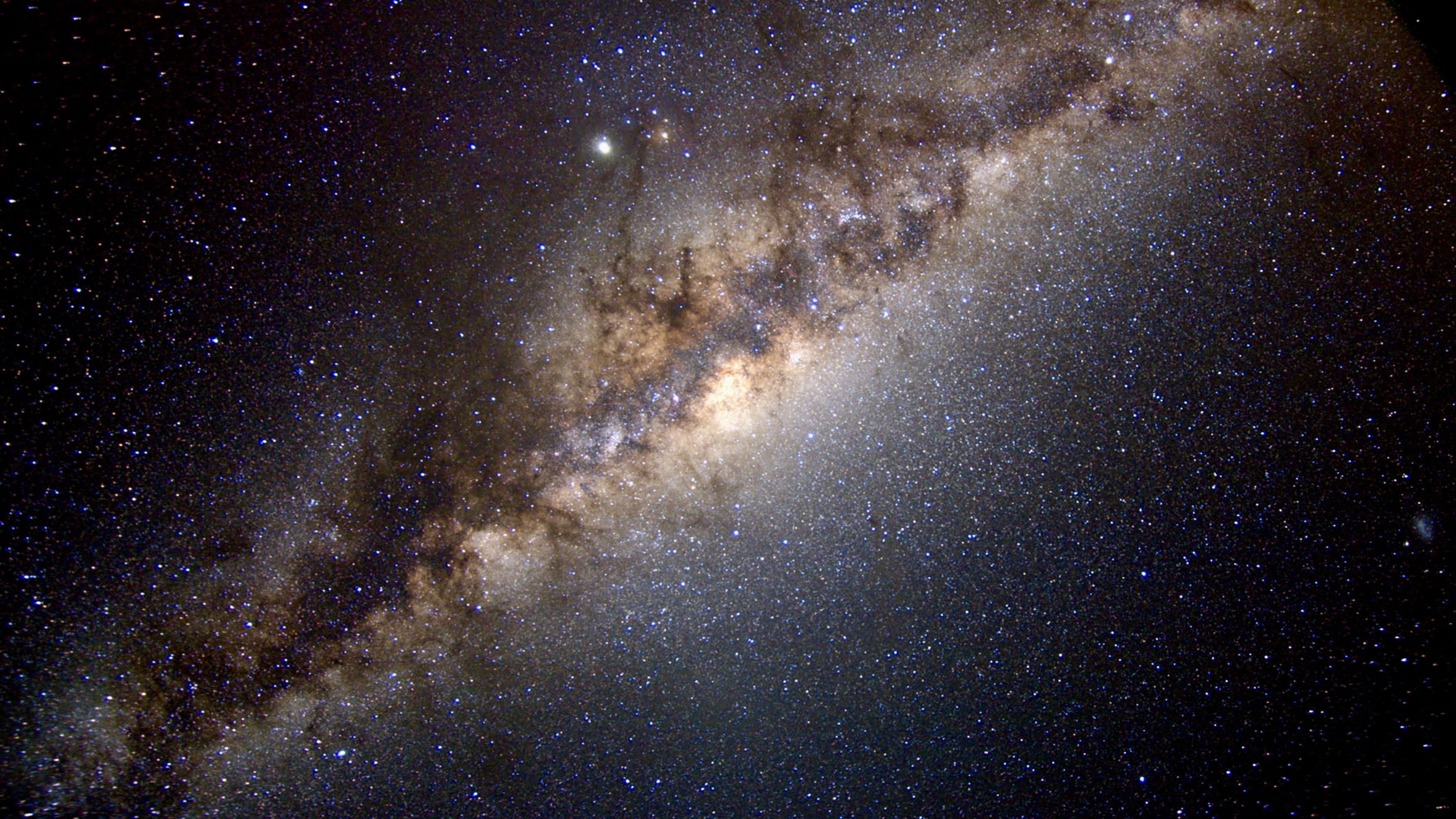
Thousands of confirmed planets and a galaxy likely containing billions more make the possibility of life difficult to ignore. Yet after decades of searching, no extraterrestrial civilization has been confirmed.
THE UNIVERSAL RECORD
Sourced reporting. No opinions.
Brad Socha | August 24, 2026 | 9:33 PM EST
The Fermi paradox begins with a deceptively simple question: if intelligent life can arise elsewhere in the universe, why have we found no convincing evidence of it?
The question has become more intriguing as astronomy has transformed our understanding of planets beyond the solar system. NASA says more than 6,200 exoplanets have now been confirmed, while billions are thought to exist across the Milky Way. Dozens of known worlds are roughly Earth-sized and orbit within their stars’ habitable zones, where temperatures could permit liquid water under suitable atmospheric conditions.
None of that demonstrates that life exists elsewhere. A planet in a habitable zone is not necessarily inhabited, or even habitable. But the sheer abundance of planets raises one of astronomy’s most enduring puzzles: if technological civilizations are possible beyond Earth, why has the universe remained apparently silent?
Why the Fermi Paradox Persists
The paradox is associated with physicist Enrico Fermi, who discussed the apparent contradiction between the possibility of extraterrestrial civilizations and the lack of evidence for them in 1950.
A related attempt to frame the problem came from astronomer Frank Drake. His 1961 Drake Equation organizes the factors that would determine how many detectable technological civilizations might exist in the Milky Way. Those include the rate of star formation, the fraction of stars with planets, the number of potentially habitable worlds, the probability of life and intelligence developing, and how long a civilization remains detectable.
Astronomy has since provided better information about some of those variables. Planets are no longer hypothetical rarities. NASA says rocky planets appear to be common, while thousands of additional exoplanet candidates remain to be confirmed.
The biological variables remain far more uncertain.
Earth provides the only confirmed example of life, intelligent life and technological civilization. Scientists therefore cannot reliably calculate how often life begins on a suitable planet, how frequently it develops intelligence or whether technological societies commonly survive long enough to become detectable.
That uncertainty creates numerous possible explanations for the apparent silence.
Life itself might be exceptionally rare. Simple organisms could be widespread while complex multicellular life is uncommon. Intelligence capable of developing advanced technology might represent another improbable evolutionary step.
Distance and time also matter. The Milky Way is roughly 100,000 light-years across. Two technological civilizations could exist but be separated by thousands of light-years, and their detectable periods may never overlap.
Humanity has also searched only a limited portion of the enormous range of frequencies, locations, signal types and times that could potentially reveal another civilization.
Searching for Technosignatures
For decades, radio astronomy has been one of the principal ways researchers have looked for evidence of extraterrestrial technology. Scientists can search observations for unusual radio emissions that could indicate artificial transmission rather than a natural astrophysical source.
The search is now broader.
NASA describes potential technosignatures as remotely detectable evidence of technology. Possibilities include radio or laser signals, artificial chemicals in an exoplanet’s atmosphere, unusual infrared emissions or, hypothetically, enormous structures designed to collect stellar energy.
So far, no observation has produced confirmed evidence of extraterrestrial technology.
That absence is important, but it does not establish that technological civilizations do not exist. Detecting one depends on what technology it uses, whether that technology produces signals detectable across interstellar distances, where astronomers look and whether the civilization exists during the same period that humans are capable of observing it.
One proposed explanation for the paradox goes further.
Economist Robin Hanson described the “Great Filter” as the possibility that one or more steps between lifeless matter and a long-lived, spacefaring civilization are extraordinarily difficult. The hypothetical filter could lie behind humanity, for example, in the origin of life or emergence of complex intelligence, or potentially ahead of us. The concept remains a theoretical framework rather than evidence that civilizations inevitably destroy themselves.
Other explanations require no catastrophic filter. Advanced civilizations might communicate in ways humans cannot recognize. They might deliberately avoid broadcasting. Interstellar expansion may prove impractical. Technological civilizations could simply be extraordinarily distant from one another.
There is also a more fundamental possibility: humanity may be unusually early, unusually rare or perhaps alone in the Milky Way at present. Existing observations cannot distinguish confidently among these possibilities.
Future telescopes could narrow the uncertainty. NASA is developing the Habitable Worlds Observatory concept to directly study potentially Earth-like planets around nearby Sun-like stars and search their atmospheres for evidence related to habitability and life.
The Fermi paradox therefore remains unresolved because its two sides are profoundly unequal. Astronomy increasingly demonstrates that planets are abundant, including worlds that occupy environments potentially compatible with life. Yet humanity still has only one known inhabited planet and one known technological civilization.
The silence does not prove that nobody else is there. It shows how little of the galaxy, and how little of the range of possible extraterrestrial technology, humanity has actually been able to examine.
The answer to “Where is everybody?” may ultimately reveal as much about the rarity and longevity of technological civilization as it does about life itself.
Sources:
NASA Science — How Many Exoplanets Are There? — https://science.nasa.gov/exoplanets/how-many-exoplanets-are-there/
NASA Science — Are We Alone? Searching for Life Beyond Earth — https://science.nasa.gov/astrophysics/science-questions/what-are-characteristics-planetary-systems-orbiting-other-stars-and-do-they-harbor-life/
NASA Science — Searching for Signs of Intelligent Life: Technosignatures — https://science.nasa.gov/universe/search-for-life/searching-for-signs-of-intelligent-life-technosignatures/
NASA Science — Are We Alone in the Universe? Revisiting the Drake Equation — https://science.nasa.gov/universe/exoplanets/are-we-alone-in-the-universe-revisiting-the-drake-equation/
SETI Institute — Drake Equation — https://www.seti.org/research/seti-101/drake-equation/
Robin Hanson — The Great Filter: Are We Almost Past It? — https://mason.gmu.edu/~rhanson/greatfilter.html
About the Author
Brad Socha is the founder of The Universal Record, focused on sourced, factual global reporting. Coverage includes international news, geopolitics, technology, and major developments.