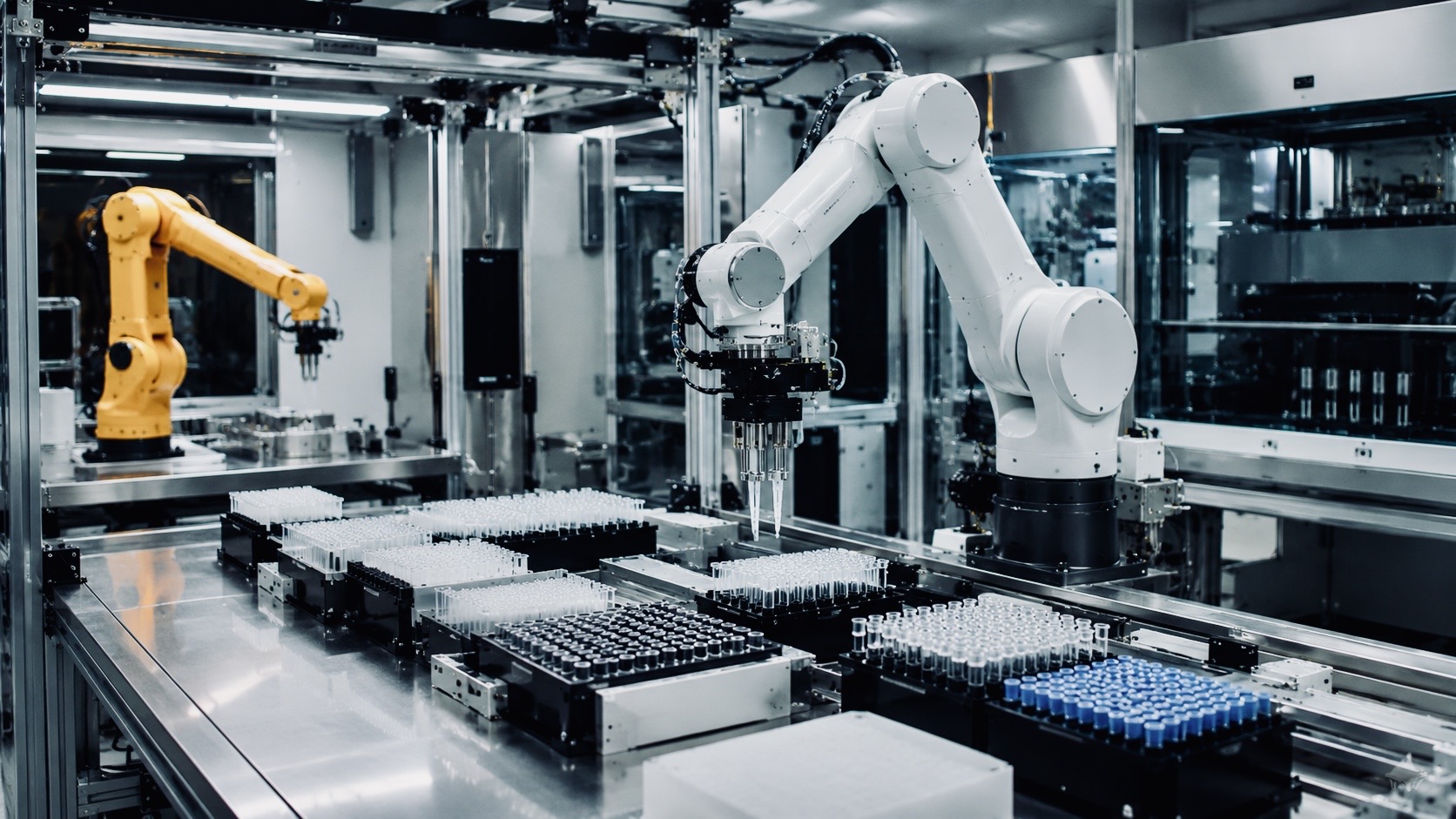
New autonomous systems can generate hypotheses, run research workflows and analyze results, but whether machines can reliably conduct science without human oversight remains unresolved.
THE UNIVERSAL RECORD
Sourced reporting. No opinions.
Brad Socha | August 23, 2026 | 3:46 PM EST
Artificial intelligence is moving beyond helping scientists search literature, write code and analyze data. Researchers are increasingly building AI systems intended to perform larger portions of the scientific process themselves, generating hypotheses, planning experiments, evaluating results and deciding what to investigate next.
Two papers released on August 14 illustrate how quickly that ambition is developing. In a new survey, computer scientist Ross D. King examines the progression toward autonomous “AI Scientists,” arguing that foundation models, autonomous agents and laboratory robotics are making more general systems technically conceivable. A separate research team introduced ScienceFlow, a framework designed to keep an AI research agent working productively across long, multi-stage investigations rather than isolated questions.
Neither development means scientists are about to disappear from laboratories. Current systems remain constrained by reliability, validation, experimental access and the difficulty of determining whether an apparently novel result is actually meaningful. But the direction of research is changing: developers are trying to automate not simply scientific tasks, but increasingly the cycle through which hypotheses become tested knowledge.
From Scientific Tools to AI Scientists
Automation in science predates modern generative AI. Laboratory robots have performed repetitive experiments for decades, while machine-learning systems have become important tools for analyzing enormous datasets and predicting biological or chemical properties.
What distinguishes an autonomous AI scientist is the attempt to connect multiple stages into a continuous feedback loop.
King defines such systems as integrated scientific agents capable of originating hypotheses, determining their consequences, designing and executing experiments, interpreting the results and revising their beliefs. They may connect to scientific literature, databases, mathematical models, simulations, analytical software and physical laboratories.
An important predecessor appeared well before large language models.
In research published in Science in 2009, King and colleagues described Adam, a robotic system that autonomously generated hypotheses about yeast genetics and experimentally tested them using laboratory automation. The researchers subsequently verified its findings independently. Adam demonstrated that parts of hypothesis-driven experimental science could be joined into an automated cycle.
Modern foundation models add something different: flexible language processing and reasoning across much broader bodies of information. AI agents can also call specialized software, write and execute code, inspect results and plan subsequent actions.
The combination creates the possibility of connecting reasoning systems to scientific instruments and allowing results from real experiments to influence what the system does next.
Yet integration remains a major obstacle. An autonomous scientist must do more than generate plausible hypotheses. It needs to distinguish evidence from error, choose informative experiments, maintain an accurate record of previous work, recognize failed approaches and produce conclusions justified by the evidence.
Those requirements expose weaknesses that current AI systems have not eliminated.
A 2026 position paper challenging claims of autonomous scientific discovery argued that today’s agentic systems still struggle with issues including selecting worthwhile problems, incorporating the tacit knowledge involved in laboratory work and obtaining meaningful feedback from physical experiments.
ScienceFlow Targets Longer Autonomous Research
ScienceFlow tackles another problem: persistence.
Many AI agents can solve bounded tasks, but scientific research rarely follows a short, predictable path. An experiment fails. A hypothesis needs revision. Computational results reveal an unexpected direction. Researchers may need to return to an earlier state and pursue another approach.
The ScienceFlow researchers designed their system around recoverable executable states. Rather than treating research as one uninterrupted sequence, the framework organizes work into segments and preserves previous states that can be revisited when a line of investigation reaches a dead end.
It also includes a controller intended to allocate computational resources according to available budget, validated progress and the status of ongoing jobs.
The researchers tested ScienceFlow across machine-learning, scientific-modelling and mathematical-optimization tasks. They report that it achieved a 70.22% “Any-Medal” score on the full MLE-bench under a 24-hour computational budget, 4.92 percentage points above previously reported results. Those results come from the authors’ preprint and should not be interpreted as evidence that ScienceFlow can independently conduct arbitrary scientific research.
That distinction is critical.
Benchmark success demonstrates performance within specified environments. Scientific discovery in the physical world requires experimental validity, reproducibility and evidence strong enough to withstand independent scrutiny.
Nature has similarly cautioned against interpreting the emergence of AI scientists as evidence that human researchers have become unnecessary. Current systems can accelerate parts of research, but human judgment remains important for deciding which questions matter, evaluating uncertain evidence and placing discoveries within broader scientific and social contexts.
The long-term ambition goes considerably further.
The Nobel Turing Challenge seeks highly autonomous AI systems capable of producing scientific discoveries at a level comparable with leading human researchers by 2050. It remains a research goal, not a forecast that such capability will necessarily be achieved.
The more immediate transformation may be less dramatic but still consequential. Scientists could increasingly supervise networks of specialized agents that search literature, propose experiments, operate simulations, analyze measurements and recommend what to test next.
In that model, AI does not replace the scientific method. It becomes part of the machinery performing it.
Whether machines eventually become genuinely independent scientists will depend on something more demanding than generating convincing ideas: demonstrating repeatedly that their discoveries survive experimentation, replication and independent human scrutiny.
Sources:
The Past and Future of AI Scientists — https://arxiv.org/abs/2608.14407
ScienceFlow: A Long-Horizon Agent for ML Research, Scientific Discovery and Beyond — https://arxiv.org/abs/2608.14354
Science — The Automation of Science — https://pubmed.ncbi.nlm.nih.gov/19342587/
University of Cambridge — Robot Scientist Becomes First Machine to Discover New Scientific Knowledge — https://www.cam.ac.uk/research/news/robot-scientist-becomes-first-machine-to-discover-new-scientific-knowledge
Agentic AI Scientists Are Not Built for Autonomous Scientific Discovery — https://arxiv.org/abs/2605.08956
Nature — Why AI Cannot Do Good Science Without Humans — https://www.nature.com/articles/d41586-026-01551-3
The Alan Turing Institute — The Turing AI Scientist Grand Challenge — https://www.turing.ac.uk/research/research-projects/turing-ai-scientist-grand-challenge
npj Systems Biology and Applications — Nobel Turing Challenge: Creating the Engine for Scientific Discovery — https://doi.org/10.1038/s41540-021-00189-3
About the Author
Brad Socha is the founder of The Universal Record, focused on sourced, factual global reporting. Coverage includes international news, geopolitics, technology, and major developments.