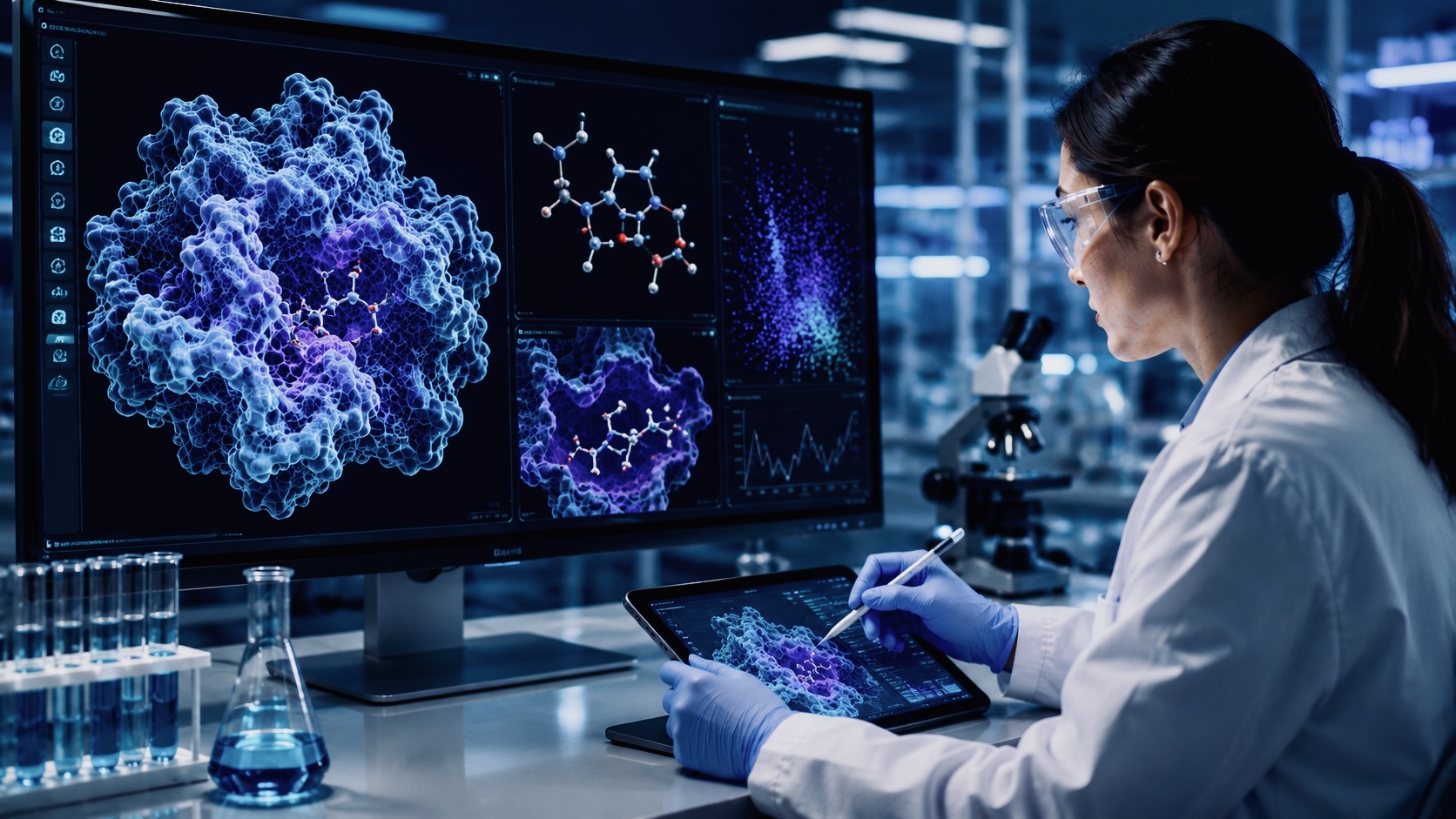
Artificial intelligence is uncovering entirely new medicines by identifying hidden biological targets and designing molecules beyond traditional human approaches. Early clinical trials are showing promising results, but scientists emphasize that laboratory testing and human trials remain essential before new treatments can reach patients.
The search for new medicines has traditionally been one of the slowest and most expensive processes in science. Developing a single drug often requires more than a decade of research, billions of dollars in investment, and the testing of thousands of chemical compounds before one proves safe and effective. Artificial intelligence is beginning to change that process, not simply by making it faster, but by discovering medicines and biological pathways that human researchers may never have considered.
Rather than replacing scientists, AI has become an increasingly powerful research partner. Advanced machine learning systems can analyze enormous biological datasets, predict how proteins fold, simulate molecular interactions, and design entirely new compounds capable of targeting disease. Researchers believe this marks one of the biggest advances in pharmaceutical research since the introduction of modern computational biology.
Proteins perform many of the body’s essential functions and are the targets for most medicines. Understanding their three-dimensional structure is critical for designing drugs that interact with them effectively. Recent AI breakthroughs have dramatically improved scientists’ ability to predict protein structures and identify potential treatment targets, reducing years of laboratory work into weeks or even days.
Modern AI systems extend well beyond protein prediction. They can estimate how experimental molecules may bind to proteins, evaluate chemical stability, predict potential side effects, and identify previously unknown binding sites that researchers might never have detected using conventional techniques. This allows scientists to explore vast regions of chemical space that would be impossible to investigate manually.
One of the organizations leading this work is Isomorphic Labs, a Google DeepMind company focused on AI-powered drug discovery. In 2026, the company introduced its Drug Design Engine, a platform designed to predict protein-ligand interactions with greater accuracy while helping researchers discover entirely new opportunities for treating disease. The goal is to shorten the earliest stages of drug development while expanding the range of biological targets available for future medicines.
The technology is already producing tangible results. One of the most closely watched examples is rentosertib (INS018_055), an experimental treatment for idiopathic pulmonary fibrosis (IPF), a progressive lung disease that causes irreversible scarring of lung tissue. Developed by Insilico Medicine, the drug was discovered using artificial intelligence to identify a previously underexplored biological target known as TNIK and to design and optimize the molecule itself. The treatment has advanced into Phase II clinical trials, where early data have shown encouraging safety and efficacy signals, although larger studies are still required before regulators can determine whether it should be approved for patients.
Cancer research is also benefiting from AI-designed therapies. Insilico Medicine’s ISM6331, developed for certain solid tumors, is currently undergoing Phase I clinical trials. Meanwhile, biotechnology companies including Recursion Pharmaceuticals, Isomorphic Labs, and several major pharmaceutical partners are applying AI to identify new drug targets, discover novel molecular structures, and accelerate research into cancer, rare genetic diseases, neurological disorders, autoimmune conditions, and metabolic illnesses.
Researchers say AI’s greatest advantage is not simply speed, it is the ability to uncover possibilities that humans may never have imagined. Traditional drug discovery typically investigates thousands or, at most, millions of candidate molecules. Generative AI systems can computationally evaluate billions, and potentially trillions, of possible molecular structures, identifying promising candidates that would likely never emerge through conventional screening methods.
This expanded search capability is especially important for diseases that have resisted existing treatments. Complex disorders such as Alzheimer’s disease, Parkinson’s disease, ALS, antibiotic-resistant infections, and many rare genetic conditions involve biological systems that remain poorly understood. AI’s ability to recognize subtle patterns across enormous datasets allows researchers to generate entirely new hypotheses for laboratory investigation.
Despite these advances, scientists consistently caution that AI is not replacing the scientific method. Every AI-generated drug candidate must still undergo extensive laboratory testing, animal studies, multiple phases of human clinical trials, manufacturing validation, and comprehensive regulatory review before becoming available to patients. Most experimental medicines, whether discovered through AI or traditional research, never reach the market.
Researchers also note that AI systems remain limited by the quality of the biological data used to train them. Unknown disease mechanisms, incomplete datasets, and the extraordinary complexity of living organisms continue to present major scientific challenges. Human expertise remains essential for interpreting AI-generated findings, designing experiments, validating results, and ensuring patient safety.
Another ongoing discussion involves transparency. Many of today’s most advanced AI drug discovery platforms are proprietary, making it difficult for independent researchers to fully examine how certain predictions are generated. Some scientists argue that greater openness could improve reproducibility and encourage broader collaboration across the global scientific community.
Investment in AI-powered pharmaceutical research continues to accelerate. Major drug manufacturers are expanding partnerships with AI companies, while governments, universities, and biotechnology firms are investing heavily in computational biology, automated laboratories, and high-performance computing. Many researchers believe these tools will increasingly shape the discovery of future vaccines, precision medicines, engineered proteins, and therapies for diseases that have long resisted conventional approaches.
Although no medicine discovered entirely by AI has yet received full regulatory approval, AI-designed drug candidates are already progressing through human clinical trials, with some demonstrating encouraging early results. As computing power, biological knowledge, and machine learning models continue to improve, researchers believe artificial intelligence will become an increasingly important partner in discovering the next generation of medicines, including treatments that may never have been found through traditional research alone.
About the Author Brad Socha is the founder of The Universal Record, focused on sourced, factual global reporting. Coverage includes international news, geopolitics, technology, and major developments.