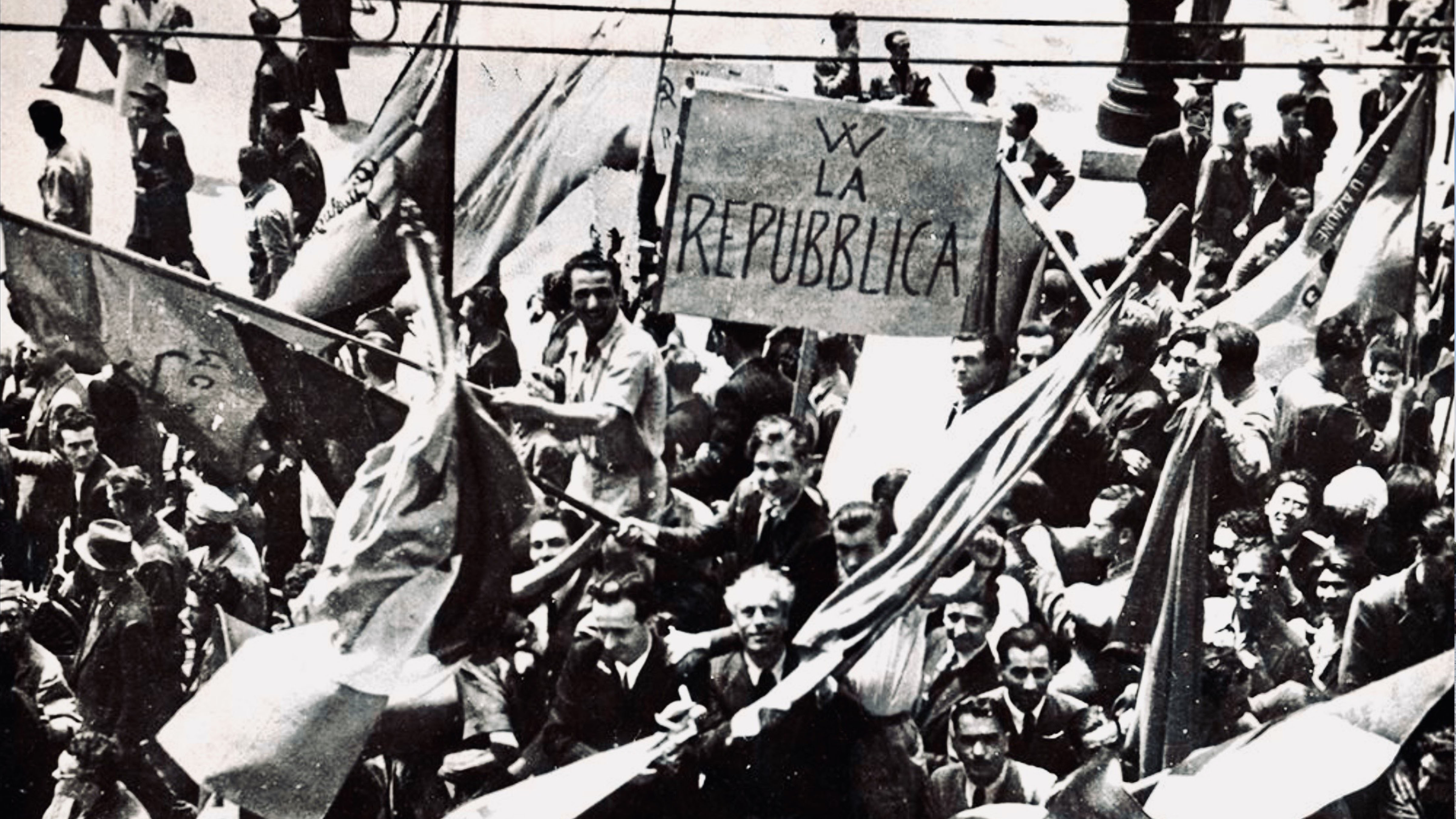
A landmark national referendum ended nearly a century of monarchy and established the modern Italian Republic following the devastation of World War II.
The referendum held in Italy on June 2, 1946, remains one of the most consequential democratic votes in modern European history. In a nation still recovering from war, occupation, economic collapse, and political upheaval, millions of Italians were asked a simple but historic question: should Italy remain a monarchy or become a republic?
The decision fundamentally reshaped the country’s political future. Italians voted to abolish the monarchy that had ruled the nation since unification in the nineteenth century and establish the Italian Republic, the system of government that continues to exist today.
The vote marked far more than a constitutional change. It represented a national reckoning with the legacy of fascism, war, and royal leadership during one of the darkest periods in Italian history.
By 1946, Italy had emerged from World War II deeply divided and physically devastated. Much of the country had experienced years of military conflict following the rise of Fascist leader Benito Mussolini, who had governed Italy since the early 1920s.
Mussolini’s alliance with Nazi Germany ultimately led Italy into a disastrous war. As Allied forces advanced through the Italian peninsula and Germany’s position weakened, the Fascist regime collapsed in 1943. Mussolini was removed from power, arrested, later rescued by German forces, and eventually captured and executed by Italian partisans in April 1945.
Although Mussolini was the central figure of Italian fascism, many Italians also blamed the monarchy for allowing the dictatorship to emerge and survive for more than two decades.
King Victor Emmanuel III had appointed Mussolini prime minister in 1922 and signed legislation that enabled Fascist control of the state. Critics argued that the monarchy failed to defend democratic institutions when it had the opportunity to do so.
As public anger grew, Victor Emmanuel III attempted to distance himself from the Fascist era by abdicating in May 1946 in favor of his son, King Umberto II.
The move came only weeks before the referendum.
Many historians believe the abdication was intended to improve the monarchy’s chances of survival. However, the effort proved insufficient.
Voting took place on June 2 and June 3, 1946. More than 24 million Italians participated in the referendum, making it one of the largest democratic exercises in the nation’s history.
The election was also significant because Italian women were allowed to vote in a national election for the first time.
Following years of dictatorship and war, millions of citizens cast ballots not only for the future form of government but also for representatives who would draft a new constitution.
When the votes were counted, approximately 54 percent supported establishing a republic, while about 46 percent favored retaining the monarchy.
Regional differences were striking.
Northern Italy, which had experienced strong anti-fascist resistance movements during the war, overwhelmingly supported the republic. Southern regions generally remained more favorable toward the monarchy.
Despite some disputes over the results, the outcome was ultimately accepted.
On June 18, 1946, Italy formally declared itself a republic.
King Umberto II left the country and entered exile. Male members of the former royal family were later barred from returning to Italy for decades under constitutional provisions that reflected lingering public distrust of the monarchy.
The referendum paved the way for the drafting of a new democratic constitution.
The Constituent Assembly elected alongside the referendum began crafting a political framework designed to prevent the return of authoritarian rule.
The Constitution of the Italian Republic entered into force on January 1, 1948.
It established a parliamentary republic, guaranteed civil liberties, strengthened democratic institutions, and created safeguards intended to prevent future concentrations of unchecked political power.
Many constitutional principles adopted during this period remain central to Italian governance today.
The importance of the 1946 referendum extended beyond Italy’s borders.
Across Europe, governments were rebuilding after the destruction of World War II. Democratic systems were being restored, economies reconstructed, and international relationships redefined.
Italy’s peaceful transition from monarchy to republic demonstrated how democratic institutions could provide legitimacy during periods of profound national transformation.
The referendum also helped integrate postwar Italy into emerging Western political structures.
Over subsequent decades, Italy became a founding member of NATO, participated in European economic integration efforts, and eventually became one of the founding states of what evolved into the European Union.
The decision made by Italian voters in 1946 therefore influenced not only domestic politics but also the broader trajectory of postwar Europe.
Today, the referendum is remembered as a defining moment in modern Italian history.
Annual Republic Day celebrations on June 2 commemorate the vote and the birth of the republic. Military parades, ceremonies, and public events are held throughout the country to mark the anniversary.
The referendum’s legacy continues to resonate because it demonstrated the power of democratic participation during a period of uncertainty and national recovery.
At a time when much of Europe faced political instability and social upheaval, Italian voters chose a new constitutional path through the ballot box rather than violence.
The result transformed Italy’s institutions, ended a monarchy that had existed since national unification, and laid the foundation for the democratic republic that governs the country today.
Nearly eighty years later, the vote remains one of the most significant examples of peaceful constitutional change in modern European history.
About the Author Brad Socha is the founder of The Universal Record, focused on sourced, factual global reporting. Coverage includes international news, geopolitics, technology, and major developments.