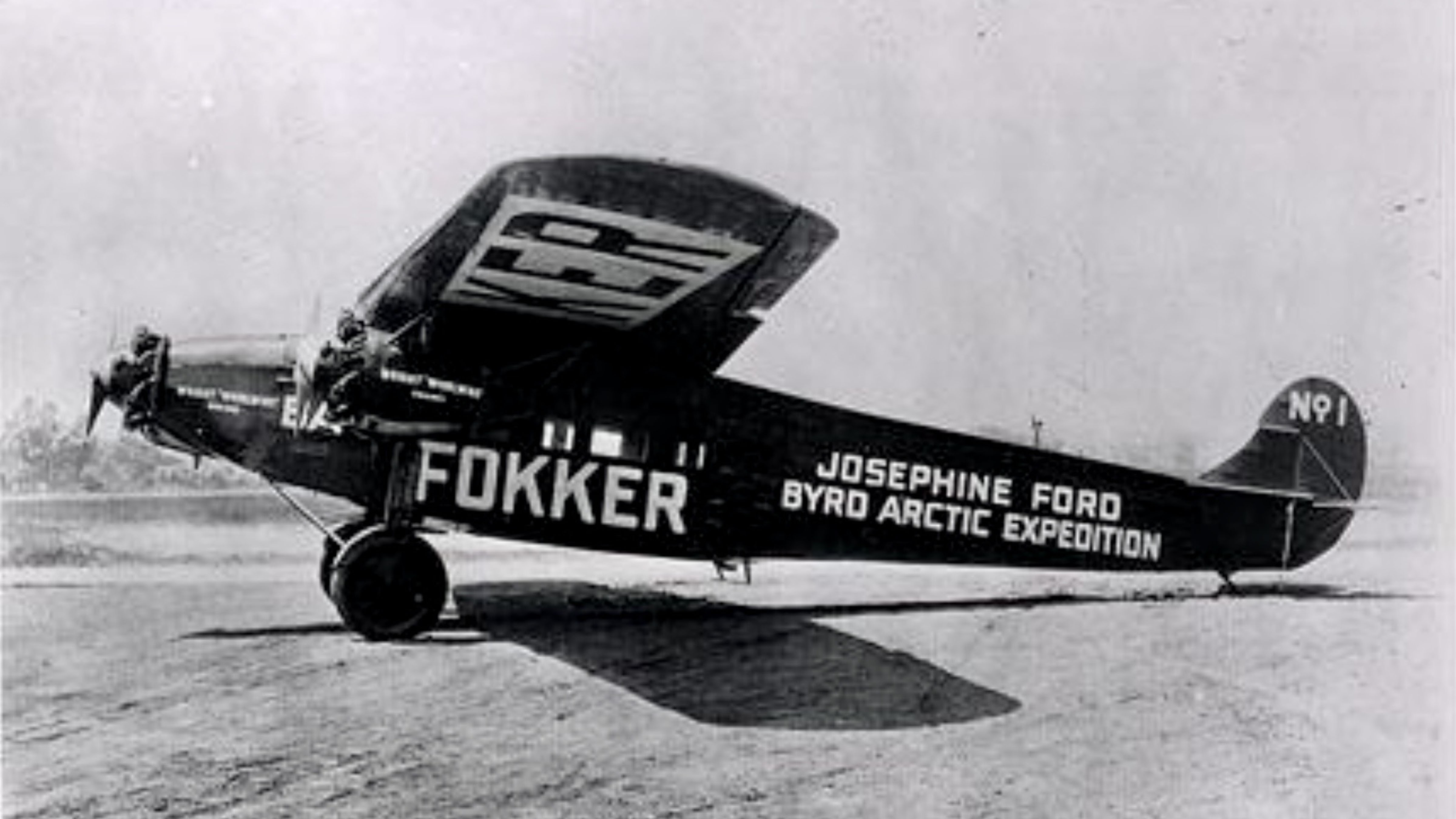
One of the most daring exploration missions of the twentieth century unfolded on May 9, 1926 when American naval aviator Richard E. Byrd announced that he and pilot Floyd Bennett had successfully completed the first flight over the North Pole. The achievement immediately captured global attention and transformed Byrd into one of the most famous explorers of his era, helping push aviation into a new age of long-distance polar flight and extreme-environment navigation.
More than a century later, the mission continues to hold historical significance not only because of its impact on aviation and Arctic exploration, but also because historians still debate whether Byrd’s aircraft actually reached the Pole before returning to base. Despite ongoing controversy surrounding navigational records and flight calculations, Byrd’s expedition remains one of the defining moments of early aviation history.
The flight took place during an era often referred to as the “Golden Age of Exploration,” when nations and explorers competed to conquer some of the planet’s most extreme and inaccessible regions. Reaching the North Pole had already become one of the world’s greatest exploration challenges by the early twentieth century due to brutal Arctic conditions, shifting sea ice, and limited navigation technology.
Byrd and Bennett launched their aircraft, a Fokker F.VIIa/3m monoplane named Josephine Ford, from Spitsbergen in Norway, now part of the Svalbard archipelago. The expedition was designed to travel north across the Arctic Ocean, fly directly over the North Pole, and return safely to base — a route considered highly dangerous given the aircraft limitations and unpredictable polar weather of the time.
The mission reportedly lasted roughly fifteen and a half hours. After returning safely, Byrd announced that the expedition had successfully reached the Pole, making international headlines almost instantly. Newspapers around the world celebrated the flight as a major scientific and technological breakthrough.
Byrd and Bennett were widely praised as national heroes in the United States. Byrd received the Medal of Honor, one of America’s highest military decorations, while the expedition itself helped elevate aviation’s reputation as a practical tool for exploration, navigation, and future transportation.
At the time, the accomplishment appeared to demonstrate that aircraft could overcome geographical barriers previously considered nearly impossible for humans to cross efficiently. Polar aviation later became increasingly important for military strategy, scientific research, weather monitoring, and eventually international commercial flight routes.
However, controversy surrounding the expedition emerged decades later after historians and researchers began reexamining Byrd’s navigation records and timing calculations. Some analysts concluded that the aircraft may not have had enough time to travel to the Pole and return given the aircraft’s speed and weather conditions reported during the mission.
Questions intensified after portions of Byrd’s original flight diary became publicly examined in later years. Some historians claimed erased calculations and altered figures suggested uncertainty regarding the exact location reached during the expedition. Others argued that difficult Arctic navigation conditions may have contributed to discrepancies without necessarily disproving the claim entirely.
The debate remains unresolved today. While many historians acknowledge significant doubts surrounding whether Byrd physically crossed the exact geographic North Pole, others maintain that the expedition still represented a remarkable aviation achievement under extraordinarily dangerous conditions.
Only days after Byrd’s claimed success, Norwegian explorer Roald Amundsen, Italian engineer Umberto Nobile, and American financier Lincoln Ellsworth completed a verified transpolar airship expedition aboard the Norge, further intensifying the race for Arctic aviation milestones.
Despite historical debate, Byrd’s influence on polar exploration became enormous. He later led multiple Antarctic expeditions, pioneered the use of aircraft in polar science operations, and helped establish new methods for aerial surveying and remote-environment logistics.
Byrd’s expeditions also captured public imagination because they blended scientific exploration with technological advancement during a period when aviation itself still seemed revolutionary to much of the world. Aircraft were rapidly transforming from experimental machines into symbols of national progress and modernity.
The North Pole itself held major geopolitical and scientific importance during the early twentieth century. Arctic exploration contributed to advances in meteorology, mapping, radio communication, and military navigation. Nations increasingly viewed polar regions as strategically important areas tied to shipping, aviation routes, and scientific observation.
Modern historians often note that Byrd’s 1926 mission symbolized humanity’s broader push to conquer extreme frontiers through technology. Even if doubts remain about the exact navigational success of the flight, the expedition demonstrated the growing capability of aircraft to operate in environments once considered unreachable.
Today, Richard Byrd remains one of the most influential figures in exploration history. His name is attached to scientific stations, polar landmarks, research programs, and historical studies involving early aviation.
The continuing debate surrounding the 1926 mission has also helped preserve public fascination with the expedition. Rather than diminishing interest, the controversy has transformed Byrd’s polar flight into one of the most discussed and analyzed exploration achievements of the modern era.
Nearly one hundred years later, the claimed North Pole flight remains a defining chapter in the history of aviation, exploration, and humanity’s relentless pursuit of the unknown.
About the Author Brad Socha is the founder of The Universal Record, focused on sourced, factual global reporting. Coverage includes international news, geopolitics, technology, and major developments.